Water Jet Cutting Systems
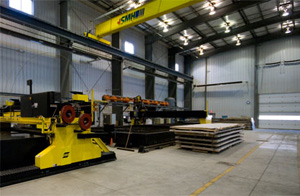
were first experimented with in the 1950s by a forest engineer Norman Franz who created a system to cut lumber. The water jet technology didn't really advance over the next 20 years until Mohamed Hashish developed the technique of adding an abrasive to the jet. Today these water jet cutting systems can cut through all kinds of materials including rubber, foam, composites, stone, plastic, paper, food, metals, tile, glass and many more. The only exceptions are with materials that are under pressure such as tempered glass and some ceramics.
How water jets work is both is simple to explain. Simply, a water jet cutter works by spraying controlled water at pressures up to 87,000 pounds per square inch (psi). There are two kinds of water jets; one is water based and called a "pure” water jet and the other has an additive called an abrasive and is called an "abrasive” waterjet.
Pure water jets are used to cut softer materials such as diapers, tissue paper and automotive interiors. Interestingly enough, the process of water jet cutting on diapers and tissue paper actually creates less moistures than if you were to cut or breathe on the product.
Abrasive water jets are different from pure water jets because they employ an abrasive particle that makes cutting hundreds or thousands of time more powerful than pure water jets. Rather than the force of the water alone causing the cuts such as in pure water jets, the abrasive particles actually cause the material to erode. The abrasive material tends to be garnet or aluminum oxide.
The way water jets are designed is simple and efficient. Water is pumped into a nozzle where it is then mixed with the abrasive. The water and abrasive continue through the tip of the nozzle at very high pressure, up to 1440 kilometers. As it hits the material for cutting, the pressure and speed of the water mixed with the abrasive cause the desired cut material to simply be cut away.
The advantages of water jet cutting are many, though two stand out to the benefit of water jet cutting systems over other cutting systems. The first is that they are not limited by thick materials. In fact, water jets can cut materials as deep as 30 centimeters where other cutting systems do not even come close to this depth. The second is the low production of heat from this system. Materials tend to be affected by high temperatures and in most cases this high temperature affects the product. With water jet cutting systems the amount of heat produced from friction is very low thanks to the stream of water passing. As the water passes, most of the heat is absorbed into the water and moved from the material.
Water jet cutting systems are incredibly simple tools that are designed for efficiency. Compared to other cutting systems, water jets are superior in nearly all applications and can cut nearly all known-to-man materials with few exceptions.